



Organic Rosemary Cineole Oil – The Focus Booster
Benefits at a Glance
- Fresh, herbaceous & camphoraceous: The invigorating scent of Mediterranean rosemary – clear, sharp and immediately awakening. Like stepping into a sun-warmed herb garden.
- The concentration champion: Rosemary cineole is one of the best-studied essential oils for mental clarity – research shows it can improve memory and cognitive performance.
- The hair care hero: Rosemary is the most popular essential oil for hair and scalp care – traditionally valued in scalp-care rituals and for soft, lightly scented hair.
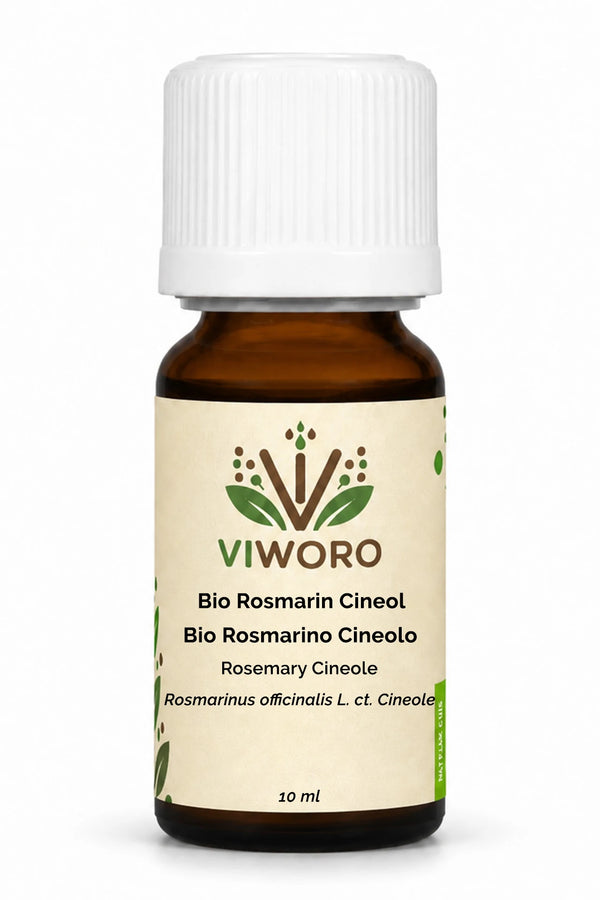
- Organic quality: 100% pure and natural, steam-distilled from flowering tops. From organic farming. From the Mediterranean – Tunisia or Spain, depending on the batch.
Application & Special Features
Application:
In a diffuser for mental clarity and focus. Diluted in carrier oil for hair and scalp care. As a revitalising massage oil for tired muscles.
Targeted uses:
In a diffuser (3-5 drops) for sharp mental focus – the ideal oil for studying, working and any task that requires concentration. For hair care, add 3-5 drops to 10 ml of carrier oil (e.g. Organic MCT Oil) and massage into the scalp before washing – or add 2-3 drops directly to your shampoo. For muscle care after exercise, dilute 3-4 drops in 10 ml carrier oil and massage into tired, tense muscles. Tip: Rosemary in the diffuser during study sessions or before exams – research confirms it supports memory retention.
Perfect Blending Partners
Rosemary Cineole is a fresh middle note with a herbaceous, camphoraceous character:
- For citrus brightness: Lemon (herbal clarity meets citrus freshness – the ultimate study blend).
- For floral balance: Lavender (rosemary energy meets lavender calm – focused but not wired).
- For minty freshness: Peppermint (two powerhouse herbs together – maximum mental clarity).

For your hair oil blend: the set or the parts
Rosemary oil is always diluted in a carrier oil. The set has everything in it – or put together your own blend.


The Herb of Remembrance
Ancient Greeks wore rosemary garlands while studying, believing it strengthened memory. Modern science has proven them right – rosemary aroma measurably improves cognitive performance.
Rosemary Chemotypes: Rosemary develops different chemical profiles depending on climate, altitude and harvest time – not on the country of origin. You don’t read the chemotype off a map, you measure it: every batch is analysed in the laboratory. The Cineole chemotype (this oil) is rich in 1,8-cineole – fresh, clear and the most versatile, the classic for mental clarity. The Camphor chemotype is warmer and more penetrating, traditional in massage blends. The Verbenone chemotype is the gentlest and popular in skincare. Our cineole rosemary comes from the Mediterranean – depending on the harvest from Tunisia or Spain. We always take the best batch available, whatever the country: the analysis decides, not the flag.
Product Information
- INCI: Rosmarinus officinalis leaf oil · CAS 84604-14-8 / 8000-25-7 · EINECS 283-291-9
- Plant: Rosemary (Rosmarinus officinalis L. ct. cineole)
- Part used: Flowering tops
- Extraction: Steam distillation
- Quality: 100% pure and natural essential oil (Organic)
- Origin: Mediterranean – Tunisia or Spain (depending on batch)
- Main components: 1,8-Cineole (38-55%), Camphor (5-15%), alpha-Pinene (9-15%), beta-Pinene, Camphene, Borneol
- Packaging: Amber glass bottle with dropper – airtight and light-protected
The Scent Profile
- Main aroma: Fresh, herbaceous and camphoraceous – the unmistakable scent of rosemary. Clear, sharp and immediately invigorating, like breathing in a Mediterranean herb garden.
- Secondary note: A fresh, eucalyptus-like quality from the high cineole content, giving it a clean, penetrating character.
- Nuance: A subtle, warm-woody undertone with hints of resin and dried herbs that add depth and grounding warmth.
Intensity: Medium-high – fresh, herbaceous and stimulating. Rosemary is the scent of waking up – clear, focused and ready for action.
The chemistry of the oil
The cineole chemotype of rosemary is characterised by its dominant molecule, 1,8-Cineole (Eucalyptol, 38-55%) – the same compound found in eucalyptus oil, responsible for that clear, penetrating freshness. A landmark study by Moss & Oliver (2012) at Northumbria University demonstrated that rosemary aroma significantly improved cognitive performance and mood – participants in a rosemary-scented room showed higher alertness and better memory scores. The mechanism? 1,8-Cineole is absorbed through inhalation and can be detected in blood plasma within minutes, where it appears to inhibit acetylcholinesterase – the same enzyme targeted by Alzheimer's medications. Alpha-Pinene (9-15%) enhances this cognitive effect and contributes a fresh, pine-like note. Camphor (5-15%) adds the warm, penetrating character – this is why rosemary massage feels pleasantly warming. Borneol and Camphene add woody-balsamic depth. In hair care rosemary is a classic: a few drops in a carrier oil for scalp massage – a pleasant ritual, with no growth promises.
The Plant
Rosmarinus officinalis (Rosemary) is an aromatic, evergreen shrub from the Lamiaceae (mint/labiate) family. Native to the Mediterranean basin, it grows wild on rocky, sun-baked hillsides from Portugal to Turkey. The name comes from the Latin "ros marinus" (dew of the sea), describing how it thrives along Mediterranean coastlines. The plant reaches 1-2 metres in height with narrow, needle-like leaves that are rich in aromatic oil glands and small, pale blue flowers that attract bees. Rosemary has been revered since antiquity – the ancient Greeks associated it with memory and scholarship, Roman brides wore rosemary garlands, and medieval Europeans burned it as protection against plague. Hot, dry Mediterranean summers and calcareous soils – from Tunisia to Spain – produce rosemary particularly rich in 1,8-cineole: the cineole chemotype.
Frequently Asked Questions (FAQ)
Does rosemary really improve memory?
Yes. Multiple studies, most notably by Moss & Oliver at Northumbria University, have demonstrated that rosemary aroma can improve cognitive performance, alertness and memory. The active molecule 1,8-cineole can be detected in blood plasma after inhalation and appears to influence neurotransmitter activity.
Is rosemary oil good for hair?
Rosemary is one of the most popular essential oils in hair care: a few drops in jojoba oil, massaged into the scalp, turn care into a pleasant ritual and leave hair soft and lightly scented. We make no promises about growth – it is a care oil, not a treatment. Dosage: 3–5 drops in 10 ml carrier oil, leave for 20–30 minutes, then wash as normal.
What is the cineole chemotype?
Rosemary produces different chemical profiles depending on climate, soil and harvest time. The cineole chemotype is rich in 1,8-cineole – best for respiratory support, mental clarity and general aromatherapy use. It's the most versatile and widely used rosemary type. Ours comes from the Mediterranean (Tunisia or Spain, depending on the batch) and every batch is analysed.
Is rosemary suitable for children?
In the diffuser, rosemary cineole is generally suitable for children over 6 years. Due to its camphor content, it is not recommended for younger children. For skin application on children, always dilute well (1 drop in 10 ml carrier oil).
Can I use rosemary during pregnancy?
Rosemary oil is generally not recommended during pregnancy, especially in the first trimester. Its camphor content and traditionally attributed emmenagogue (menstruation-stimulating) properties warrant caution. Consult your healthcare provider before use.
How should I store the oil?
Keep away from direct light and heat sources. The amber glass bottle protects from UV radiation. Close tightly after use. Rosemary oil retains its quality for several years when stored correctly.
Choose Your Size
Organic Rosemary Cineole Essential Oil
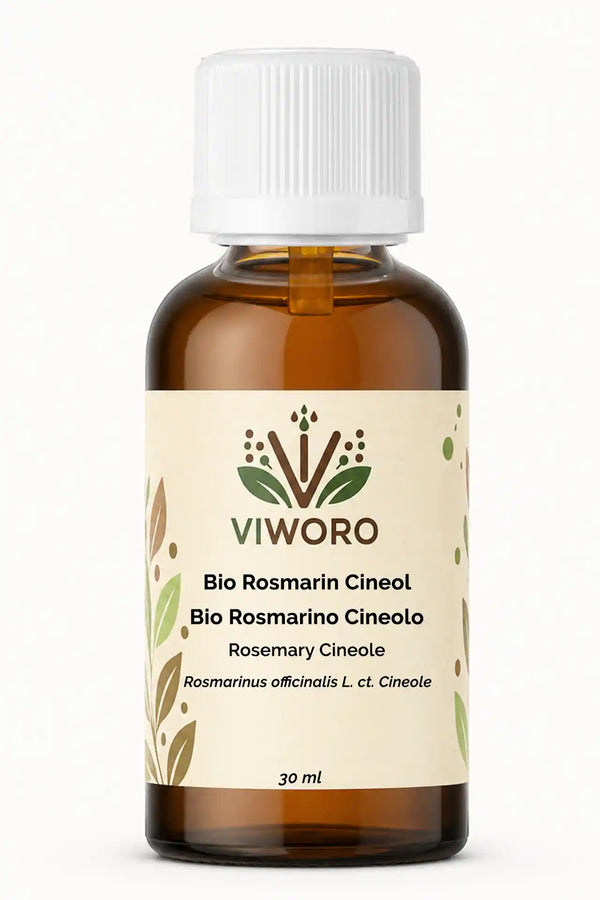
10 ml Bottle
10,00 €
Your daily focus booster – for work, study and clarity.
Recommended
30 ml Bottle
23,25 €
For hair care and daily use. You save!
Important Safety Information
- Use only diluted. Avoid contact with eyes and mucous membranes.
- Keep out of reach of children. Not recommended for children under 6 years.
- Not recommended during pregnancy (especially first trimester).
- Not suitable for people with epilepsy (camphor content).
- May cause skin sensitisation – always perform a patch test.
- For aromatic and external use only.